What does the olive oil polyphenol health claim actually mean?
Understand the authorised olive oil polyphenol claim, its dose conditions and what human studies do and do not show about cholesterol and heart health.

“Olive oil polyphenols contribute to the protection of blood lipids from oxidative stress” is an authorised EU health claim. It describes a specific effect. It does not say that an oil prevents heart disease, lowers cholesterol, reduces blood pressure or improves athletic performance.
The claim came from a scientific assessment by the European Food Safety Authority (EFSA) and was authorised by the European Commission. Its wording and conditions appear in Commission Regulation (EU) No 432/2012. This is where the much-quoted polyphenol threshold comes from.
What are blood lipids and oxidative stress?
Blood lipids include fats transported in particles such as low-density lipoprotein, or LDL. Oxidation is a chemical process that can alter those particles. Researchers can measure indicators of oxidative damage in blood samples.
The authorised claim says that olive oil polyphenols contribute to the protection of blood lipids from oxidative stress. It is not a diagnosis, a promise that someone will notice a change or proof that an oil prevents disease. EFSA’s original scientific assessment supported this particular effect for olive oil polyphenols characterised by hydroxytyrosol and its derivatives.
What did researchers actually test?
A pivotal randomised crossover trial involving 200 healthy men compared three otherwise similar olive oils with low, medium and high phenolic concentrations. Participants consumed 25 ml daily during three-week intervention periods, separated by washouts. Researchers measured blood lipids and markers of lipid oxidative damage, not rates of heart attacks or long-term disease.
The study is valuable because it compared actual oils at a daily food dose. It also has limits: the participants were healthy men, each intervention lasted three weeks, and the highest-concentration oil tested contained 366 mg/kg of phenols. It was not a trial of every high-polyphenol oil now on sale.
What does an oil need to meet the EU claim?
The EU regulation says the claim may be used only for olive oil containing at least 5 mg of hydroxytyrosol and its derivatives per 20 g of oil. If a business uses the claim, it must also tell consumers that the beneficial effect is obtained with a daily intake of 20 g of olive oil.
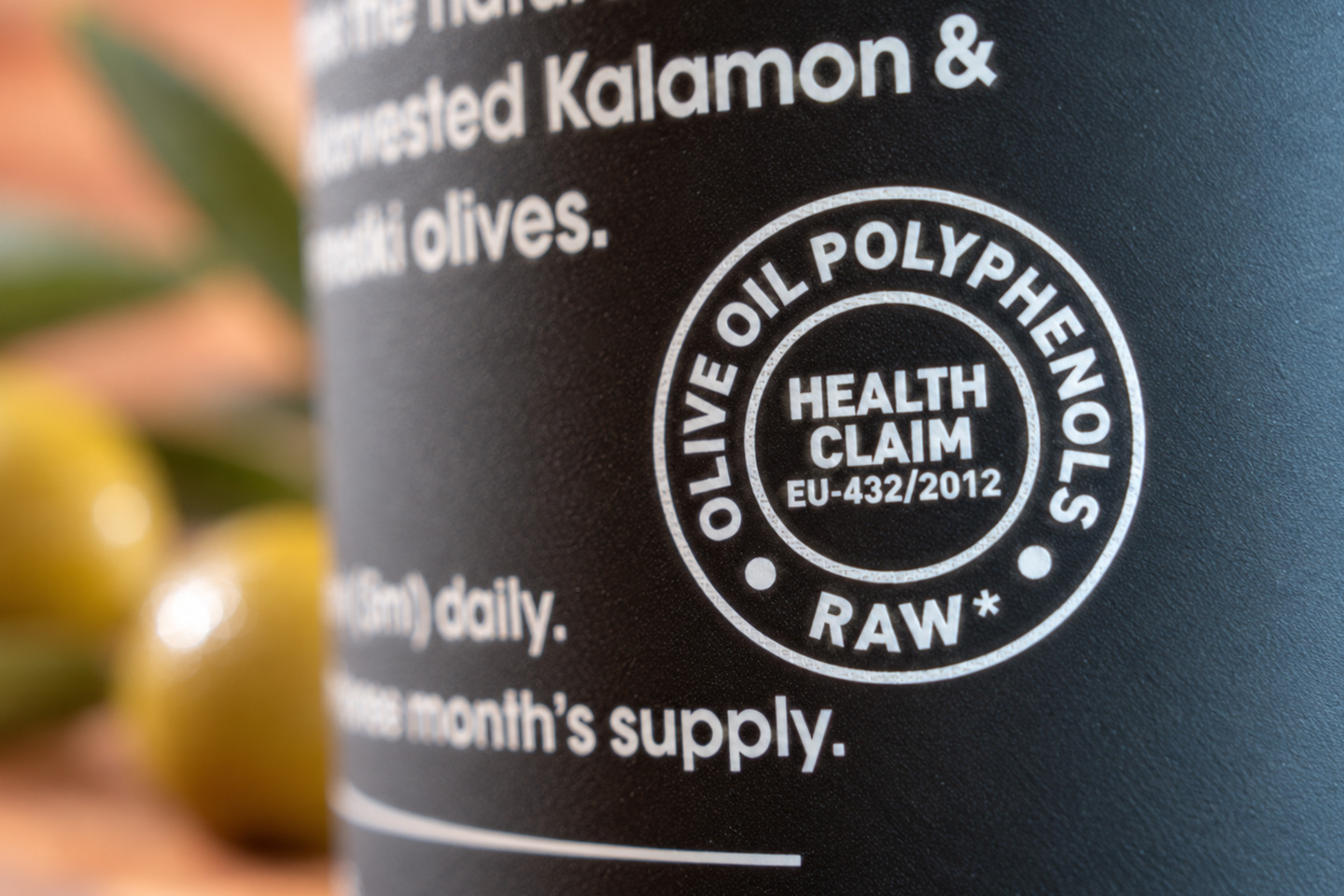
These figures are the conditions for using the health claim, not a minimum polyphenol standard for selling olive oil in the EU. An oil can be sold without making this claim. The threshold also does not divide all olive oils into “healthy” and “unhealthy”, or measure how much benefit a person will receive.
Two details matter when reading a label or laboratory report. First, the condition concerns hydroxytyrosol and its derivatives, not simply any impressive “total polyphenols” figure. Second, 20 g is a weight of oil, not 20 ml or an unspecified tablespoon.
A batch report can help establish what was measured in a particular oil. To support use of this claim, the evidence needs to address the qualifying compounds and the conditions attached to the claim. A large total expressed in mg/kg does not settle that question on its own.
What about RAW+ in the UK?
The claim originated in EU law, but Great Britain and the EU now maintain separate health-claims systems. For claims made in England, Scotland and Wales, businesses should check the Great Britain nutrition and health claims register. The EU rules remain the relevant starting point for a claim used in EU markets, and EU nutrition-claims law also continues to apply in Northern Ireland.
The central point for a reader is the same: check the exact authorised wording, the qualifying compounds and the stated daily amount. A high result on a bottle is useful information about its composition, but it is not a licence to make broader health promises.
Does this mean olive oil raises “good cholesterol”?
No such conclusion follows from the authorised oxidative-stress claim. The original trial reported a dose-related increase in HDL cholesterol across the oils, which was an interesting finding. One study, however, is not the entire evidence base.
In a 2025 assessment of a proposed HDL claim, EFSA found that the three-week result had not been consistently supported by other studies or replicated in other populations and settings. There was also no evidence that the effect would last with longer continuous consumption. EFSA concluded that the submitted evidence was insufficient to establish the proposed claim about maintaining normal HDL cholesterol.
That does not make the earlier trial worthless. It means a promising result for one marker cannot be promoted into a reliable general promise.
What about LDL cholesterol, blood pressure and heart disease?
Those are different questions again. A separate 2025 EFSA assessment considered a proposed claim about lowering LDL cholesterol and systolic blood pressure, and consequently reducing coronary heart disease risk. EFSA did not establish the proposed cause-and-effect relationship.
Protecting blood lipids from oxidative stress and lowering the amount of LDL cholesterol in the blood are different outcomes. Neither should silently become “prevents heart disease”.
How to read the next claim you see
Ask four questions:
- What is the exact claimed effect? Oxidative damage, cholesterol concentration, blood pressure and disease events are different outcomes.
- What was consumed in the research? Whole olive oil, an extract and an isolated compound are not interchangeable.
- What was the dose, duration and population? A three-week study in healthy men cannot answer every question about years of use in everyone.
- Does this oil meet the conditions for this claim? Look for relevant batch evidence and the stated daily amount.
The EU olive oil polyphenol claim matters because it gives a precise, evidence-assessed statement that qualifying oils may use. Understanding exactly what it says makes it easier to appreciate high-polyphenol olive oil without stretching a specific claim into a promise the research has not established.
Sources and evidence note
- Great Britain nutrition and health claims register: authorised wording and conditions for use in Great Britain.
- EFSA scientific opinion (2011): assessment of LDL-particle oxidative damage and other proposed olive-polyphenol claims.
- Covas and colleagues, Annals of Internal Medicine (2006): randomised crossover comparison of three oils in 200 healthy men.
- EFSA HDL assessment (2025): insufficient evidence for the proposed HDL maintenance claim.
- EFSA LDL and blood-pressure assessment (2025): proposed disease-risk-related claim not substantiated.
Subscribe to our Newsletter
Read other articles