NEW SEASON COMING SOON
The last of this season’s RAW+® is now on offer.
The next harvest is on its way. Shop this season’s remaining RAW+® bottles at reduced prices while stocks last or join the waitlist to hear when the new season arrives.
The next harvest is on its way. Shop this season’s remaining RAW+® bottles at reduced prices while stocks last or join the waitlist to hear when the new season arrives.
Meet the olive compounds behind a rich phenolic profile, from oleocanthal to hydroxytyrosol, and learn why the mix matters.
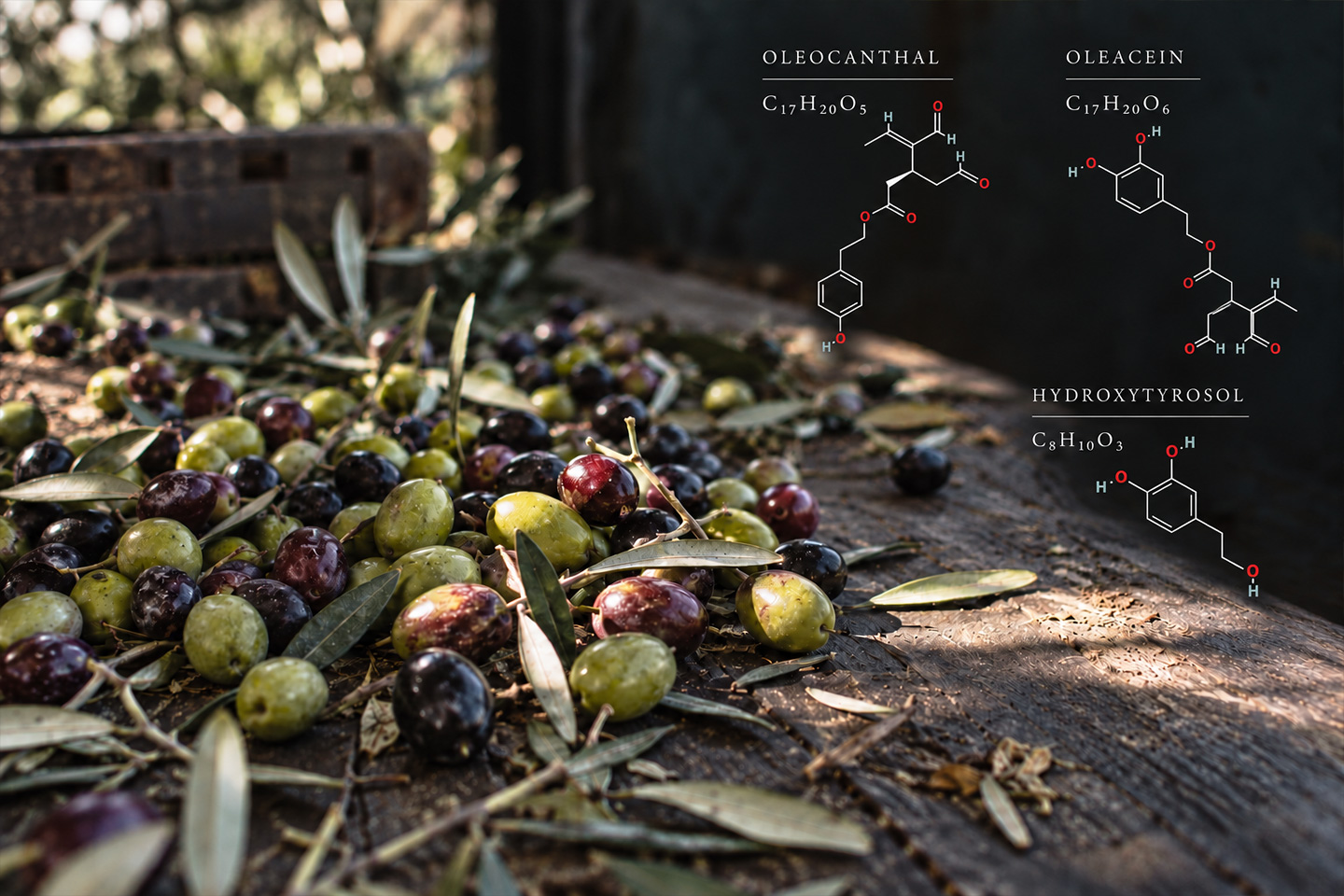
Olive oil polyphenols are a family of natural compounds, each adding something to an oil's character and chemistry. Extra virgin olive oil can contain secoiridoids such as oleocanthal and oleacein, simpler phenolic alcohols such as hydroxytyrosol and tyrosol, and smaller amounts of lignans, flavones and phenolic acids.
This variety is a strength. The blend changes with olive variety, ripeness, milling and storage. A total-polyphenol result is useful, and a report naming individual compounds can tell you still more about the oil in a particular batch.
Food science uses several overlapping terms, including phenols, phenolic compounds, biophenols and polyphenols. In everyday olive-oil discussion, “polyphenols” is usually the broadest and most recognisable label.
Chemically, the family is more complicated than the name suggests. Some olive compounds have one phenolic ring, while others have larger or transformed structures. The International Olive Council's analytical method refers to “biophenolic minor polar compounds” and includes natural and oxidised derivatives of oleuropein and ligstroside, lignans, flavonoids and phenolic acids.International Olive Council method for determining biophenols in olive oils
For a reader, the useful point is simple: “polyphenols” does not mean one substance added at a fixed dose. It means a profile.
Secoiridoids are especially important in virgin olive oil. They originate from compounds in the olive fruit, then change as the fruit is crushed and the paste is mixed during extraction.
Oleuropein and ligstroside are prominent precursors in olives. Enzymes released during crushing convert them into aglycones and related derivatives that enter the oil. Among the better-known products are:
A study of six olive cultivars grown in the same orchard identified 33 phenolic compounds in the fruits and 20 in their corresponding oils. The profiles differed by cultivar, and secoiridoids showed the highest transfer rates among the groups studied.From Olive Fruits to Olive Oil: Phenolic Compound Transfer in Six Olive Cultivars
This helps explain why olive variety and processing affect more than the size of a total. They can alter which compounds dominate the finished oil.
Hydroxytyrosol and tyrosol are smaller phenolic compounds. They can occur freely in oil, but they also form part of larger secoiridoid structures.
Over time, some larger compounds break down and the free forms can increase even while the wider phenolic profile is changing. This is one reason a higher reading for a single simple phenol does not necessarily mean the oil has become richer in every sense.
Hydroxytyrosol and its derivatives are important in the wording and calculation behind the authorised olive-oil-polyphenol health claim. That does not make hydroxytyrosol a stand-alone promise. The claim has defined composition and daily intake conditions, and it concerns protection of blood lipids from oxidative stress.
Pinoresinol and 1-acetoxypinoresinol are lignans found in virgin olive oil. They are a different structural family from the secoiridoids.
They receive less attention in consumer language, partly because oleocanthal, oleacein and hydroxytyrosol have become more recognisable names. Their presence is another reminder that an oil's phenolic fraction is wider than its headline compounds.
Luteolin and apigenin are examples of flavones that may appear in virgin olive oil. Various phenolic acids can also be detected, often at lower concentrations.
These smaller groups may contribute to the laboratory profile, but a report that lists them should not be read as a separate clinical benefit for every line item. Detection, composition and human outcome are different levels of evidence.
An olive does not simply hand a fixed set of molecules to the oil.
In the six-cultivar study, only five identified compounds were found in both the fruit and the corresponding oil. Many fruit compounds were transformed during crushing and malaxation, while much of the fruit's water-soluble phenolic material left with the aqueous and solid by-products.From Olive Fruits to Olive Oil: Phenolic Compound Transfer in Six Olive Cultivars
Several factors shape the profile:
The result is a moving composition, not a permanent fingerprint set at harvest.
Oleocanthal is linked to the peppery catch of some oils. Oleacein, hydroxytyrosol and other olive compounds are also studied for their biological roles. Learning their names helps explain why two oils with similar total readings can taste and behave differently.
Human nutrition studies usually test whole oils, which bring a mixture of phenolics, fatty acids and other components together. That makes the full food an interesting subject in its own right. When discussing a health result, describe the oil or diet that was actually tested rather than assigning the effect to one molecule without evidence.
The strongest well-known human evidence usually compares oils with different overall phenolic concentrations, rather than comparing equal oils that differ in only one named phenol.
In the EUROLIVE trial, 200 healthy men at six European centres consumed 25 mL per day of three similar olive oils containing 2.7, 164 or 366 mg of phenols per kilogram. Each intervention lasted three weeks, with two-week washout periods in the randomised crossover design. Researchers measured blood lipids, lipid oxidative damage and antioxidant markers.The effect of polyphenols in olive oil on heart disease risk factors
Some measured lipid and oxidative-damage markers changed in a dose-related direction across the oils. The trial was short, involved healthy men and measured biomarkers. It did not test RAW+, prove a disease-prevention outcome or identify oleocanthal, oleacein or another single compound as the cause.
A separate randomised crossover study gave 12 healthy volunteers specially prepared virgin olive oils containing 250, 500 or 750 mg of total phenols per kilogram. After the acute intakes, plasma metabolites related to hydroxytyrosol increased with the oils' phenolic concentration.Impact of olive oil phenolic concentration on human plasmatic phenolic metabolites
That shows absorption and metabolism of compounds from the oils. It does not show that one phenolic profile is universally “best”, or establish a long-term clinical outcome.
The most accurate summary is that humans absorb and metabolise components of the olive phenolic mixture, and trials have found changes in some biomarkers when overall phenolic content differs. Evidence for isolated claims about each named compound is much thinner.
A laboratory total is not like counting identical coins.
The International Olive Council HPLC method extracts the minor polar compounds, separates them by high-performance liquid chromatography and detects them at 280 nanometres. In one IOC method, the combined result is expressed as milligrams per kilogram of tyrosol equivalents.International Olive Council method
That phrase matters. “Tyrosol equivalents” means the response of several compounds is being represented using tyrosol as the reference. It is not a statement that every milligram measured is literally tyrosol.
The IOC document also notes that different extraction and quantification methods can produce different results. A method using individual response factors may estimate compounds differently from one that quantifies them all against a single standard.
Other approaches, including colorimetric assays, chromatography with different detectors and nuclear magnetic resonance methods, may define or calculate totals differently.
So when comparing reports, ask:
A larger number from a different method may not be a fair like-for-like comparison.
Start with the question you want the report to answer.
If you want to know whether the oil contains a substantial measured phenolic fraction, a clear total from a stated method can help.
If you care about the profile, look for named compounds and the method used to quantify them. Do not assume that two equal totals contain equal amounts of oleocanthal, oleacein or hydroxytyrosol.
If someone makes a health claim, move beyond the chemistry. Ask whether the wording is authorised, whether all conditions are met and whether the evidence concerns the oil, an extract or an isolated compound.
Finally, keep time in the picture. A report describes the tested sample at a point in its life. Harvest, processing and storage can all change the mixture.
Olive oil's phenolic family is rich and varied. Oleocanthal, oleacein, hydroxytyrosol and related compounds help explain its distinctive taste and why a detailed batch report can be so informative. Look at the measured total, the named compounds and the method together to understand the oil you are choosing.
Compare three strengths of batch-tested, high-polyphenol extra virgin olive oil.
Shop the range