NEW SEASON COMING SOON
The last of this season’s RAW+® is now on offer.
The next harvest is on its way. Shop this season’s remaining RAW+® bottles at reduced prices while stocks last or join the waitlist to hear when the new season arrives.
The next harvest is on its way. Shop this season’s remaining RAW+® bottles at reduced prices while stocks last or join the waitlist to hear when the new season arrives.
Early harvest often favours a rich polyphenol profile. See how fruit ripeness, careful milling and batch testing reveal what is in your oil.

Yes! harvesting olives earlier often favours a richer phenolic profile. As fruit ripens, its chemistry changes, and studies in several cultivars have found higher measured phenolics in oils made from less-ripe olives. The International Olive Council also identifies ripeness, climate, production and storage as influences on phenolic content.
That gives “early harvest” real meaning. To see the result achieved in a particular oil, pair the production story with a batch-specific laboratory report showing the measurement, units and testing date. This connects a promising choice in the grove to evidence from the bottle.
Olives change chemically as they develop and ripen. Their phenolic compounds do not all rise or fall together, and different cultivars follow different patterns.
In a controlled study of Greek olive varieties, researchers examined oils made from Koroneiki fruit across five harvest periods and varied the temperature and duration of malaxation. Total phenolic content was negatively associated with ripening and with longer malaxation, although individual compounds behaved differently.[2]
Another study followed three Turkish olive cultivars across harvest periods. The highest measured phenolic content occurred in the early harvest period, while the scale and pattern of change differed by cultivar.[3]
So the practical rule is modest, not absolute: harvesting less-ripe fruit often favours a higher phenolic concentration, but the variety and everything that happens next still matter.
There is also a sensory and production trade-off. Less-ripe fruit generally yields less oil and can produce a more assertive flavour. A higher phenolic reading is not the only marker of a good oil, and the most bitter bottle is not automatically the best fit for every meal.
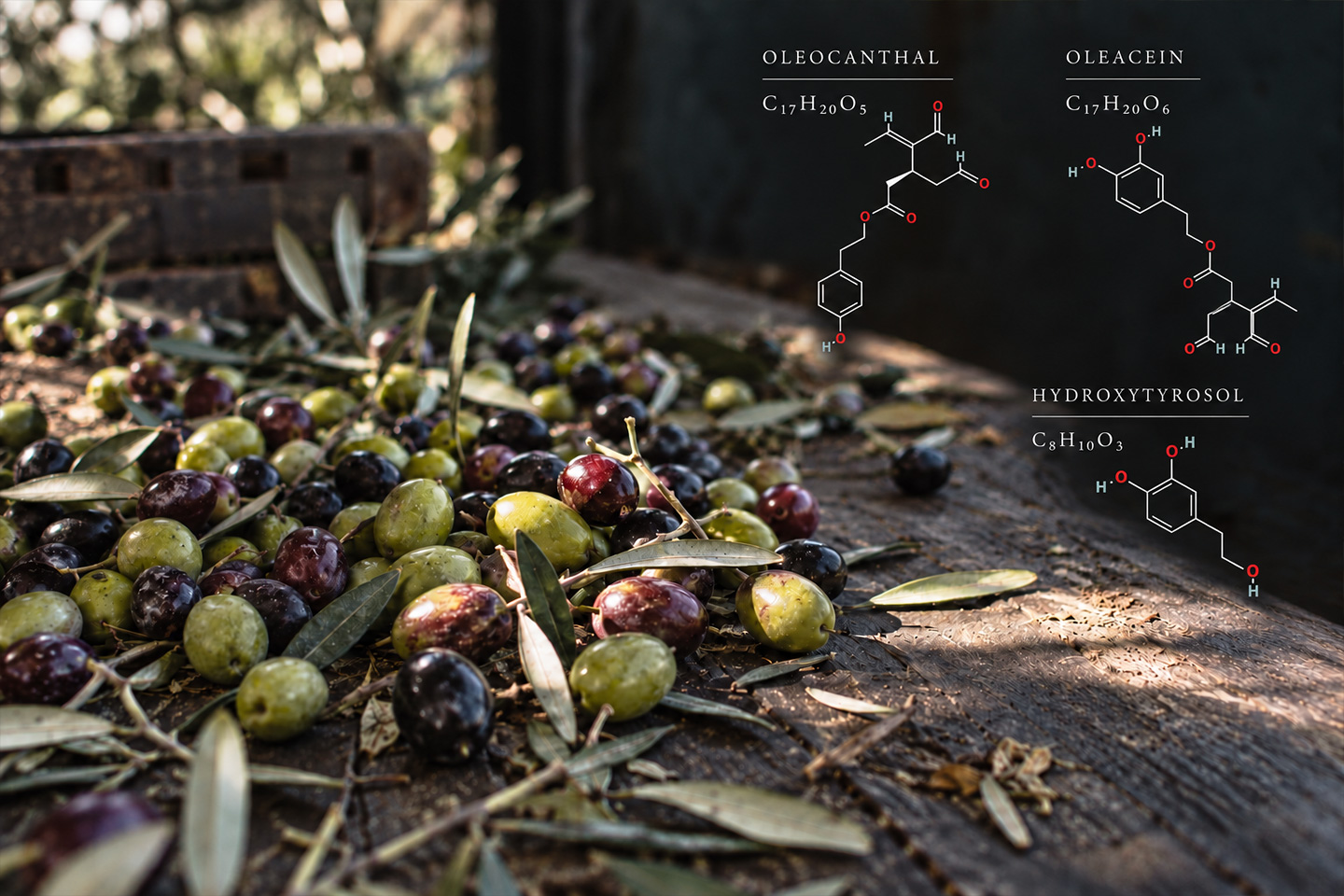
Cultivar matters because different olive varieties have different genetic and biochemical profiles. Weather, water availability, fruit health and the timing of the growing season also influence the raw material.
This is one reason a calendar date cannot define “early” everywhere. The relevant question is how ripe the fruit was in that place, variety and season. The Greek study's authors cautioned that optimal harvest timing can shift with climate conditions from year to year.[2]
Once olives are picked, bruising, heat and delays before milling can encourage oxidation and fermentation. Clean fruit that reaches the mill promptly gives the producer a better starting point.
This does not mean a short harvest-to-mill claim proves a high phenolic result. It means that avoidable damage has been reduced. The final concentration still depends on the fruit and the full extraction process.
Milling breaks the olives into a paste. That releases oil, water and enzymes from different parts of the fruit and brings them into contact.
Some reactions help form or release phenolic compounds into the oil. Others contribute to oxidation or further transformation. The result is not a simple matter of preserving a fixed number that already existed inside the whole olive.
Malaxation is the slow mixing of crushed olive paste. It allows tiny oil droplets to join so the oil can be separated more efficiently.
Temperature and time influence extraction yield, aroma and phenolic composition. It is tempting to turn this into a slogan such as “colder is always higher in polyphenols”, but the evidence is more complicated.
In the Greek study, changing malaxation temperature produced different effects according to cultivar, harvest point and individual phenolic compound. In some Koroneiki conditions, a rise from 22°C to 28°C or 32°C increased measured total phenolics or particular compounds. Longer mixing tended to reduce total phenolics, but the response again varied.[2]
A 2025 review reached the same broad conclusion: malaxation affects polar phenolic compounds through solubilisation and enzymatic and chemical reactions, with outcomes shaped by several technological and biological factors.[4]
The honest takeaway is that the producer is optimising a system, not turning one magic dial.
After malaxation, the oil must be separated from water and olive solids. It may then be filtered and stored before bottling.
Oxygen, light, time and temperature can continue to change the oil. Filtration has trade-offs because removing water and suspended material can support stability, while the immediate effect on individual phenolic compounds depends on the oil and process.
By the time a bottle reaches a kitchen, the measured profile reflects the whole chain. Harvest timing is only one link.
These phrases can describe real production choices. They are not, by themselves, measurements of phenolic concentration.
Early harvest suggests the fruit was picked at a less-ripe stage. It does not tell you the cultivar, exact maturity index, mill settings, storage history or final laboratory result.
Cold extracted describes a temperature-related processing claim. It does not show that one oil contains more phenolic compounds than another. As the malaxation research shows, the relationship between temperature and phenolic composition is not linear or identical across cultivars.[2]
Peppery or bitter flavour can be consistent with phenolic compounds, but tasting is not a substitute for quantitative analysis. Sensory character is influenced by variety, ripeness, volatile compounds, freshness and individual perception.
A label can help you ask better questions. It cannot replace the answer from the batch.
A useful report should make it possible to identify what was tested and how. Look for:
Avoid ranking oils by numbers taken from reports that use different methods or definitions. A larger number is not automatically a fair comparison if one test measures a broad total and another measures a narrower group of compounds.
It is also worth separating a composition result from a health conclusion. A laboratory measurement can tell you about the oil sample. It does not show that a particular person will experience a particular outcome.
Use three layers of evidence.
1. First, consider the production story. Variety, maturity, prompt milling and careful extraction can make biological and practical sense.
2. Second, look for batch-specific measurement. This is the strongest way to support a statement about the composition of the oil you are buying.
3. Third, check freshness and handling. A relevant test, suitable packaging and sensible storage are more useful together than a striking number with no date or batch link.
This approach is less exciting than treating one label phrase as proof. It is also more reliable.
Early harvest is a purposeful step towards a vibrant, phenolic-rich oil. Variety, season and skilful milling shape the result, and a clear batch test shows what those choices delivered. Look for both the story and the measurement when choosing an oil.
Compare three strengths of batch-tested, high-polyphenol extra virgin olive oil.
Shop the range